Not long ago, bicycle parking in commercial real estate was an afterthought. A simple U-rack bolted near a side entrance was considered enough, designed only for casual riders who happened to stop by. Today, cycling has evolved from a hobby into a mainstream commuting choice, and developers, property managers, architects and tenants are demanding much more.
From street-level sidewalk amenities to high-rise office towers and large mixed-use districts, commercial real estate is redesigning its approach to cyclists. Bike parking is no longer just furniture; it is a tenant amenity, a sustainability credential, a compliance requirement, and a competitive advantage for buildings. Property portfolios that ignore cycling infrastructure risk falling behind on leasing targets, green certifications, and local zoning rules.
In this article, we break down why commercial real estate is shifting toward better cycling infrastructure, what types of bike solutions work best for different building types, common design pitfalls, and how partnering with an experienced bike rack manufacturer helps deliver projects on spec and on budget.
Why Cycling Amenities Are Now a Commercial Real Estate Priority
Commercial property decisions ultimately come down to value: higher occupancy, stronger tenant retention, easier leasing, and lower long-term operational risk. Cycling infrastructure checks all these boxes.
Tenant Expectations for Office and Mixed-Use Buildings
Modern tenants, especially tech firms, creative studios and professional service businesses, rank active transportation amenities highly when selecting office space. Employees increasingly ask for safe, convenient bike parking instead of extra car parking. A building with secure, well-organized bike storage becomes easier to market to younger talent and sustainability-focused companies.
Retail destinations also benefit. Shoppers on bikes tend to make frequent, local visits. A convenient bike parking zone close to main entrances encourages repeat foot traffic, without consuming valuable car parking space.
Zoning Rules, Green Building Credits and Compliance
Cities around the world keep updating zoning codes to mandate minimum bicycle parking ratios for new construction and major renovations. Requirements differ by location, but many jurisdictions separate short-term visitor parking from secure long-term employee parking. LEED, BREEAM and other green building frameworks also award points for quality end-of-trip cycling facilities.
For developers, this means bike parking must be included in schematic design, not added during construction as a last-minute fix. Late changes often lead to cramped layouts, non-compliant rack spacing, theft risks and rework costs.
Reduced Pressure on Car Parking
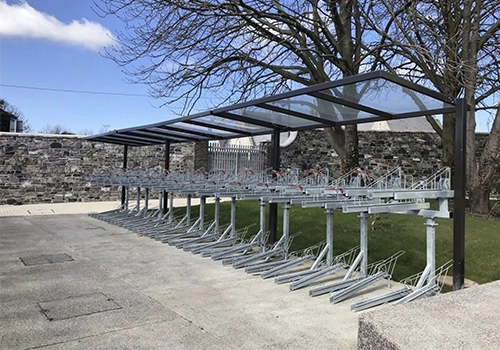
Parking garages are expensive to build and maintain. Every square metre converted from car parking to efficient bike storage cuts construction costs while supporting mobility goals. Stacked, high-density bike rack systems let developers serve dozens of cyclists within a footprint smaller than one standard car bay.
Different Building Types Need Different Bike Parking Strategies
One-size-fits-all bike racks rarely work across commercial real estate. A sidewalk retail spot has different needs from a basement-level office secure bike room.
Ground-Level Retail & Plaza Spaces
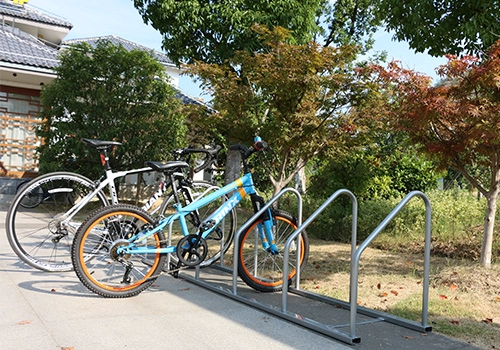
Retail bike parking prioritizes visibility and quick access. Visitors stay for shorter periods, so simple, vandal-resistant racks near main entry points are ideal. U-racks and wave racks are popular choices, easy to use and instantly recognizable. Materials must resist heavy foot traffic, salt, rain and UV exposure.
Key design points: keep racks clear of pedestrian walkways, avoid blocking accessibility routes, and leave enough clearance for handlebars.
Mid-Rise and High-Rise Office Towers
Office buildings need a two-tier approach: short-term visitor racks near the lobby, plus locked, long-term secure storage for daily commuters. Many premium towers add end-of-trip facilities such as showers, changing rooms and lockers alongside bike parking.
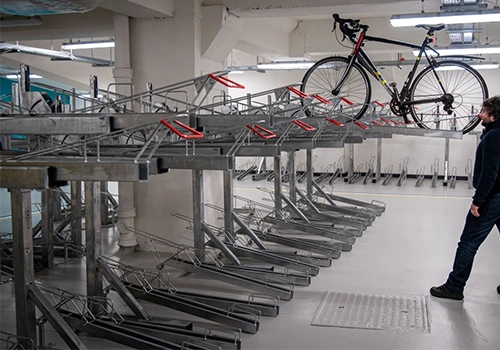
Basement and underground bike rooms are common for high-rises. Here, space efficiency matters most. Double-decker bike racks, vertical racks and modular systems maximize capacity within limited floor space. Proper lighting, drainage and controlled access are critical for user confidence.
Mixed-Use Districts
Mixed-use sites combine offices, retail, restaurants and residential units. This creates a complex mix of users: shoppers, workers, residents and delivery riders. Successful designs zone parking clearly: short-term racks for retail, secure long-term racks for office staff, and separate resident bike storage.
Modular systems are the best fit here, because developers can expand or reconfigure layouts as the district matures and occupancy patterns change.
Core Design Features Commercial Buyers Should Prioritize
When sourcing bike parking for commercial projects, property managers and architects look beyond basic appearance. These features separate durable, high-performance systems from low-quality alternatives.
Theft Resistance
Commercial bike storage must reduce theft risk. Well-designed racks support the bike frame and wheel, allowing cyclists to lock with standard U-locks. Avoid lightweight decorative stands that only secure a single wheel. For high-value fleets and regular commuter bikes, lockers and enclosed bike rooms add an extra security layer.
Space Efficiency and Ergonomic Spacing
Poor rack spacing creates frustration: bikes get tangled, doors cannot open, users struggle to roll cycles in and out. Every commercial bike layout should follow clear dimensional standards for aisle width, rack offset and handlebar clearance. This is where factory engineering support adds real value: a reliable bike rack supplier can provide CAD layout drawings to validate capacity before installation.
Weather Resistance and Low Maintenance
Outdoor commercial racks face year-round exposure. Powder-coated steel, hot-dip galvanized steel and stainless steel resist rust, scratches and corrosion. Low-maintenance finishes reduce painting and replacement cycles, which lowers the lifetime cost for property owners.
Scalable, Modular Construction
Large developments often phase construction. Modular bike rack systems let owners start with a baseline number of spaces and add more modules later, without replacing the whole installation. This flexibility is a major advantage for growing commercial districts.
How Suzhou Pioneer Vehicle Supports Commercial Real Estate Projects
As a professional bike rack manufacturer, Suzhou Pioneer Vehicle works directly with developers, architects, contractors and property management teams to deliver commercial-grade bicycle parking solutions tailored to building specifications.Our product portfolio covers the full range of commercial requirements: standard sidewalk U-racks, wave racks, high-density two-tier stacked systems, vertical bike racks, secure bike lockers and custom fabricated units. We manufacture in our own factory, which means we control material selection, welding quality, surface treatment and packaging for export projects.
We support B2B buyers with technical documentation, CAD layouts, load testing reports and compliance guidance. If your project needs custom dimensions, branding or special finishes, our engineering team can adjust designs to match architectural intent and local code requirements.Whether you are fitting out a small retail plaza, designing a secure bike room for a 30-storey office tower, or planning a full mixed-use mobility hub, we help you balance capacity, safety, budget and aesthetics. Our bike racks are built for heavy daily commercial use, engineered to reduce maintenance and withstand harsh outdoor environments.
Common Mistakes That Derail Commercial Bike Parking Projects
Even experienced teams run into avoidable issues when cycling infrastructure is not planned early.The first mistake is underestimating demand. Many developers install the legal minimum number of bike spaces, only to see them fully occupied soon after opening. Adding extra capacity during the design phase is far cheaper than retrofitting later.
The second mistake is choosing racks based only on upfront price. Thin, poorly finished racks may look economical at first, but they bend, rust and require replacement within a few years. Total cost of ownership matters more than unit price for commercial assets.The third mistake is ignoring accessibility. A bike parking area is only useful if all users can reach, load and unload bikes safely. Aisles, slopes, entry points and clear zones must be considered for inclusive design.
The Future: Smart Bike Parking for Next-Generation Commercial Buildings
The shift is not stopping at stronger and denser racks. Forward-looking commercial real estate is beginning to integrate smart bike parking: occupancy sensors, access control systems, reservation modules and lighting linked to usage. These upgrades fit premium-grade office and mixed-use assets, improving user experience and giving property managers real-time data on how facilities are used.
Even so, the foundation remains the same: robust, well-engineered bike racks. Smart features add value, but they cannot compensate for a poorly designed, weak or incorrectly spaced rack system.
Conclusion
Cycling infrastructure has moved from the sidewalk fringe into core commercial real estate strategy. Today’s best developments treat bike parking as a first-class amenity, planned alongside elevators, lobbies and car parking. It attracts quality tenants, supports sustainability goals, satisfies municipal rules and improves the public perception of a property.
For architects, developers and procurement teams, choosing the right bike rack partner matters. You need a manufacturer who understands commercial site constraints, compliance standards and long-term durability. Suzhou Pioneer Vehicle combines factory production capacity, engineering support and commercial project experience to deliver reliable bike parking solutions for buildings from sidewalk retail to high-rise skyscrapers.
If you are planning a commercial development renovation or new build and need technical support, layout drawings or a quotation for commercial bike racks, contact our team today.