


ChinaBikerack
Bike Parking Solution Supplier
ChinaBikerack
Bike Parking Solution Supplier

Specifications
Model Number : PV-SC-001
Type: Bike parking and storage
Color:Yellow,Black,Green,Red,or Customized.
Style : both indoors and outside
Material : carbon steel
Loading: According to customer need
Size :195*23.2*75cm,200.55*23.2*75cm,or Customized.
Finish: hot-galvanized

Specifications
Model Number : PV-0081-01
Type: Bike parking and storage
Color:silver
Style : both indoors and outside
Material : carbon steel
Loading: According to customer need
Size :Height 1463mm, Depth 1114mm
Finish: hot-galvanized

Model Number : PV-0081-01
Type: Bike parking and storage
Color:Black
Style : both indoors and outside
Material : carbon steel
Loading: 2-10 bikes (According to customer need)
Size :Height 1463mm, Depth 1114mm
Finish: hot-galvanized

Model No.: PV-H1
Size: w605*D400*H330mm
Specification: Round tube:¢16*1.2mm
Finish: Power coated
Net Weight: 1.6 kgs
Packing size:6pcs/ctn
MOQ: 100pcs

Model Number : PV-0024-01
Material : carbon steel/stainless steel
Loading: according customer space size,we can design according the size
Size : W1977*D1130(depend on your parking space)*H2500mm
Finish: Powder coated ,hot-galvanized/electric polish
Packing size :2000*2000*2500mm(40 parking space )
Powder coated ,hot-galvanized/electric polish

Product number:PV-0046-01
Material:carbon steel
Specification:10.2*59*28CM or Customized.
MOQ:100PCS
Port:Shanghai
Trademark:PV

Model Number : PV-0081-01
Type: Outdoor Bike Parking Rack
Style : both indoors and outside
Material : carbon steel
Loading: 2-10 bikes (According to customer need)
Size :170.5*116*148CM
Finish: hot-galvanized

Model Number : PV-0055-01
Type: compact flat pack /slot
Color:black / silver /yellow/optional
Style :Outdoor/indoor
Material : carbon steel/ stainless steel
Capacity : park 6 bikes
Size : L1400*W1054*H840mm
Net weight :38KG
Finish: powder coating / hot galvanized /elctropolishing
Packing size :1490*860*160mm 1pcs/ctn

Product Name: Multi-Capacity Horizontal Two Tier Bike Parking Rack
Material: Carbon Steel
Finish: Powder coated
Post: 80mm * 80mm thickness: 3mm
Steel plate: thickness: 2mm
Dimension: 1325*1890*1830mm
Weight: 370 kg/set

Model: PV-0067-01
Material: stainless steel 304
Pipe: 50 mm* 2.5 mm
Size: 900*700 mm(L*W)
Surface treatment: polishing
Every bike rack looks fine on installation day. The differences show up in year three, year eight and year fifteen — as rust streaks on the pavement, bent hoops, snapped bolts and repeated repair invoices. That is why "maintenance-free" is one of the most overused and least verified claims in the bike parking market.
Strictly speaking, no outdoor steel bike rack is truly maintenance-free. What buyers actually need is a low-maintenance rack: one that holds its structure and appearance for decades with nothing more than occasional inspection and cleaning. This guide explains what separates a genuinely low-maintenance bike rack from a cheap one that quietly consumes budget, and what to check before you sign a municipal or commercial purchase order.
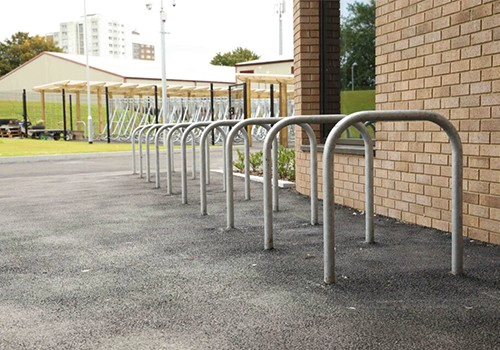
Procurement decisions often compare unit price per rack. That comparison is misleading, because the purchase price is only the first instalment. The real cost includes repainting, rust removal, re-anchoring, replacement labour, delivery of spare parts and the administrative work of raising repair tickets — plus the reputational cost of a bike parking area that looks abandoned.
Consider two scenarios over a fifteen-year horizon. A budget rack at a low unit price, replaced twice and repainted once, with two rounds of anchor repair. A properly galvanized rack at roughly double the unit price, installed once, inspected annually, never repainted. For most public and commercial projects, the second option is dramatically cheaper per year of service, and it avoids the disruption of closing a parking area for repairs.
So the question is not "which rack costs less today," but "which rack costs least to own." That reframes the entire specification process, from material choice to fastener selection.
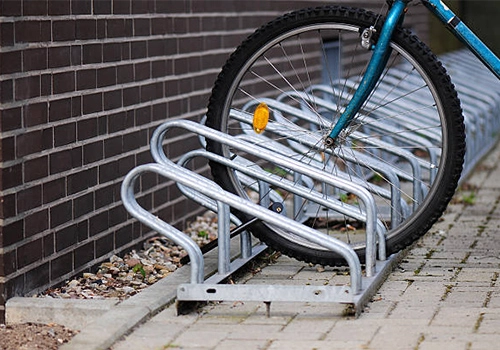
Hot-dip galvanizing is the backbone of low-maintenance outdoor steel. The zinc coating protects the steel in two ways: it forms a barrier against moisture, and it corrodes preferentially, protecting exposed steel at scratches and cut edges.
The protection depends on coating thickness, and thickness is governed by standards, not marketing language. Buyers should ask which standard the coating is certified to — ASTM A123 for North American projects, EN ISO 1461 for European specifications, or an equivalent national standard — and request the measured zinc thickness in micrometres. A typical hot-dip galvanized coating falls in the range of 70 to 85 μm across most structural grades, with heavier coatings achievable on thicker sections.
A "galvanized" rack with a thin, uneven coating will show rust at weld lines and cut ends within a few seasons. This is one of the most common failure points in cheap imported racks, and it is almost impossible to detect visually at delivery. Ask for certification, not a photo.
This is the specification detail most buyers miss. Hot-dip galvanizing after fabrication covers the whole part, including welds and cut tube ends, provided the fabricator prepared the steel correctly. Problems arise when racks are:
Buyers should confirm the sequence: fabricate first, then galvanize, then powder coat if a colour finish is required. This sequence is the single largest determinant of long-term appearance.
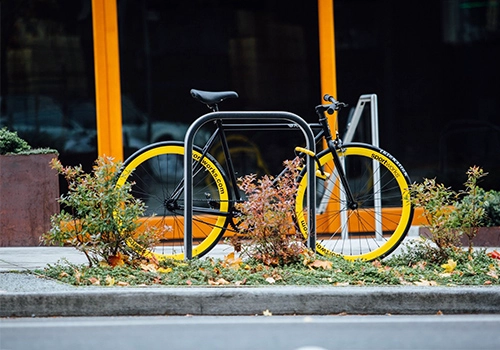
A rack that bends, sways or cracks requires structural repair — the most expensive kind of maintenance. Wall thickness and weld integrity decide whether the rack survives e-bikes, rough handling and vandalism. Thin-wall tube saves material cost and creates exactly the deformation and cracking problems that later demand replacement.
Where welding is unavoidable, full penetration welds, ground smooth where visible, eliminate crevices that trap moisture and eliminate pry points. Buyers can ask for wall thickness specifications in writing and for weld inspection practice at the factory. A supplier who cannot state the tube wall thickness in millimetres is not a serious manufacturing partner.
Water is the enemy of any coating. Racks that trap water in closed loops, sealed tube ends or concave joints corrode from the inside out, and the damage is invisible until the tube perforates. Good design includes drainage holes at low points, sealed or capped open ends, and geometry that does not hold standing water.
Similarly, tight crevices between tube and mounting plate trap moisture and debris. Simple, clean geometry with open joints and generous radii reduces both corrosion risk and cleaning effort.
Bolts are the most frequently ignored failure point in bike parking. Standard zinc-plated or plain steel bolts on a hot-dip galvanized rack create a dissimilar-metal couple. The bolt corrodes quickly, seizes in the hole, and becomes impossible to remove when a repair is finally needed. Once a seized bolt must be cut out, the "maintenance-free" claim is over.
Specify stainless steel fasteners, or fasteners galvanized to the same standard as the rack. Also specify the mounting hardware itself: security anchors, tamper-resistant heads and anchor plates that resist removal. On coastal or de-icing-salt sites, stainless fasteners are essential.
The rack-to-ground connection determines whether the structure stays put. In-ground embedded mounting, set into properly cured concrete, delivers the most stable and lowest-maintenance result. Surface mounting with security anchors is more flexible for retrofits but depends entirely on anchor quality and concrete condition.
Buyers should require installation drawings specifying embedment depth, concrete grade, anchor type and curing requirements. Cutting corners at this stage — shallow embedment, insufficient concrete, undersized anchors — shows up as wobbling racks and lifted base plates within a few years, and repairs at the base are the hardest to execute.
Finish consistency. Where powder coating or a coloured finish is specified, ask for the RAL colour reference and for coating thickness in micrometres, plus a salt-spray test reference if the site is aggressive. Colour mismatch between shipments is a common annoyance on multi-phase projects.
Spare-part and module strategy. Even low-maintenance racks occasionally need a single hoop or anchor replaced after a vehicle strike. Modular designs allow single-element replacement; monolithic designs require full removal.
Warranty terms. A structural warranty of ten years or more, with explicit coverage of corrosion perforation, indicates a manufacturer confident in its coating process. Vague promises are not warranties.
Documentation. Ask for material certificates, coating certification and factory inspection records. This documentation is what protects a public buyer during audit and handover.
The failure pattern in low-cost bike racks is remarkably consistent: pre-galvanized tube welded after coating, thin walls, exposed cut ends, plain steel bolts, no drainage and no coating certification. Each of these saves a small amount of money at the factory and creates a much larger cost at the site. Municipal and commercial buyers inherit that cost, along with complaints from cyclists who abandon a parking area that rusts, bends or loses its anchors.
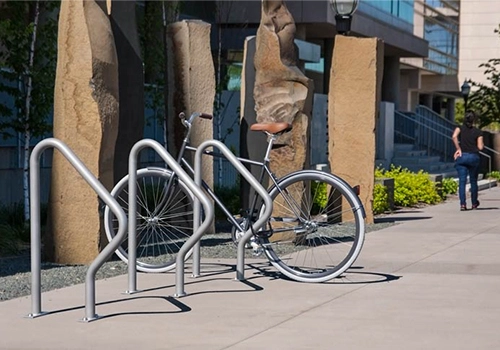
At Suzhou Pioneer Vehicle, low-maintenance performance is engineered into the process rather than promised in the brochure. Our workshop handles cutting, precision mandrel tube bending, welding, hot-dip galvanizing to recognised standards and powder coating in specified RAL colours, with material and coating certificates issued per order. We supply U-racks, wave racks, spiral racks and custom bike parking designs for municipal, campus, retail and residential projects, with stainless steel options available for coastal and heavy-salting environments.
Custom bike racks and standard ranges are built with drainage-aware geometry, sealed tube ends, stainless fasteners and security anchor options, and we provide installation drawings that specify embedment and concrete requirements so the rack performs as designed. If you are specifying a project and want to compare lifecycle cost rather than unit price, our team can prepare a technical datasheet and quotation for your site conditions.
Maintenance-free bike racks are not a marketing category; they are a set of verifiable engineering decisions: heavy walls, certified hot-dip galvanizing applied after fabrication, treated welds and cut ends, drainage-aware geometry, stainless fasteners and a properly engineered ground connection. Buyers who check these six points will avoid the hidden cost cycle of rust, repair and replacement, and will end up with bike parking that looks and performs the same in year twelve as it did in year one.
If you would like a specification checklist to use in your next tender, contact our team at Suzhou Pioneer Vehicle for technical documentation on our low-maintenance bike parking solutions.