


ChinaBikerack
Bike Parking Solution Supplier
ChinaBikerack
Bike Parking Solution Supplier

Specifications
Model Number : PV-SC-001
Type: Bike parking and storage
Color:Yellow,Black,Green,Red,or Customized.
Style : both indoors and outside
Material : carbon steel
Loading: According to customer need
Size :195*23.2*75cm,200.55*23.2*75cm,or Customized.
Finish: hot-galvanized

Specifications
Model Number : PV-0081-01
Type: Bike parking and storage
Color:silver
Style : both indoors and outside
Material : carbon steel
Loading: According to customer need
Size :Height 1463mm, Depth 1114mm
Finish: hot-galvanized

Model Number : PV-0081-01
Type: Bike parking and storage
Color:Black
Style : both indoors and outside
Material : carbon steel
Loading: 2-10 bikes (According to customer need)
Size :Height 1463mm, Depth 1114mm
Finish: hot-galvanized

Model No.: PV-H1
Size: w605*D400*H330mm
Specification: Round tube:¢16*1.2mm
Finish: Power coated
Net Weight: 1.6 kgs
Packing size:6pcs/ctn
MOQ: 100pcs

Model Number : PV-0024-01
Material : carbon steel/stainless steel
Loading: according customer space size,we can design according the size
Size : W1977*D1130(depend on your parking space)*H2500mm
Finish: Powder coated ,hot-galvanized/electric polish
Packing size :2000*2000*2500mm(40 parking space )
Powder coated ,hot-galvanized/electric polish

Product number:PV-0046-01
Material:carbon steel
Specification:10.2*59*28CM or Customized.
MOQ:100PCS
Port:Shanghai
Trademark:PV

Model Number : PV-0081-01
Type: Outdoor Bike Parking Rack
Style : both indoors and outside
Material : carbon steel
Loading: 2-10 bikes (According to customer need)
Size :170.5*116*148CM
Finish: hot-galvanized

Model Number : PV-0055-01
Type: compact flat pack /slot
Color:black / silver /yellow/optional
Style :Outdoor/indoor
Material : carbon steel/ stainless steel
Capacity : park 6 bikes
Size : L1400*W1054*H840mm
Net weight :38KG
Finish: powder coating / hot galvanized /elctropolishing
Packing size :1490*860*160mm 1pcs/ctn

Product Name: Multi-Capacity Horizontal Two Tier Bike Parking Rack
Material: Carbon Steel
Finish: Powder coated
Post: 80mm * 80mm thickness: 3mm
Steel plate: thickness: 2mm
Dimension: 1325*1890*1830mm
Weight: 370 kg/set

Model: PV-0067-01
Material: stainless steel 304
Pipe: 50 mm* 2.5 mm
Size: 900*700 mm(L*W)
Surface treatment: polishing
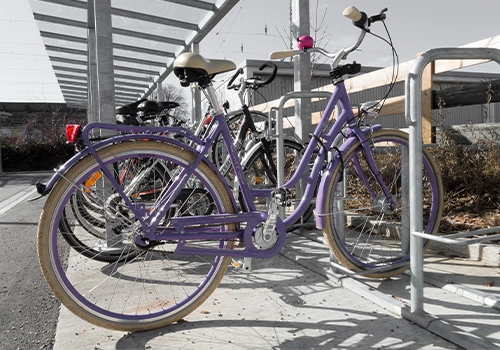
Anyone who has parked a bicycle in a crowded public lot knows the frustration: handlebars locked together, frames scraped, tires pinched, and riders struggling to squeeze their bikes out without knocking over neighboring cycles. Many people blame careless parking, but the root cause is often hidden in engineering: poorly designed rack spacing.
For city planners, property managers, schools and commercial buyers, bike racks are far more than simple metal rails. Every gap, every clearance measurement and every layout decision directly affects safety, usability and long-term durability. At Sustainable galvanized steel bike racks Suzhou Pioneer Vehicle, as an experienced bike rack manufacturer, we design every product around proven spacing standards, balancing capacity, accessibility and protection for every cyclist.
Rack spacing covers two core measurements: the distance between adjacent parking positions on the same rack, and the aisle clearance between rows of racks. These two sets of numbers work together. Reduce one, and the whole system becomes risky.
The parking slot spacing controls whether two bikes can coexist without interference. When a bike is locked into a U-rack, wave rack or spiral rack, its handlebars, pedals and front wheel extend outward. If slots sit too close, these protruding parts overlap. Even if the rack itself looks sturdy, overlapping bikes create friction, scratches and trapped wheels.
Aisle spacing controls movement. Riders need room to walk, swing their bikes, mount locks and pull their bicycles in and out. Narrow aisles turn a quiet parking zone into a hazard, especially during rush hour or at busy transit stations.
Standards vary by region, but most widely accepted guidelines set individual bike slot spacing at a minimum of 30 inches (76 cm). For high-traffic areas, designers often increase this to 36 inches (91 cm). Row-to-row aisles generally require a clear width of at least 48 inches (122 cm), while accessible parking spots for adaptive bikes and wheelchair users demand even more generous space.
Compressing spacing to fit more bikes seems like an easy way to raise parking capacity. In practice, it creates a cascade of safety problems.
First, pinched bicycles increase fall risk. When one cyclist pulls their bike free, nearby bikes are easily bumped and topple over. Falling metal frames can strike ankles, knees or young children playing nearby. In public spaces, this opens property owners to liability if injuries occur.
Second, tight gaps make secure locking harder. Many riders cannot get a U-lock around both frame and wheel when neighboring bikes block access. Instead, they lock only the front wheel or use shorter cables, dramatically raising theft risk. The rack fulfills its visual purpose but fails at its core job: protecting bicycles.
Third, damaged bikes lead to unhappy users. Scraped paint, bent brake levers, scratched wheel rims and twisted gear cables are common complaints in poorly spaced parking. Over time, cyclists avoid these locations, and the investment in bike infrastructure goes underused.
For commercial and municipal buyers, this is an important point. A cheaper rack with dense spacing may look economical on the quote sheet, but it delivers poor user experience and higher maintenance complaints.
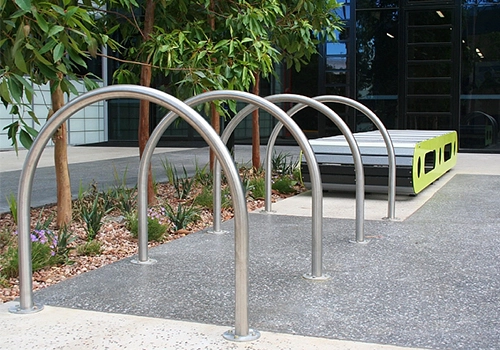
Different rack types require different spacing rules. A compact spiral rack, a standard U-rack and a heavy-duty wave rack each have unique footprint requirements.
U-racks are the most common. A single-sided U-rack usually follows the 30–36 inch slot rule. Double-sided U-racks need extra consideration because bikes park on both sides; if the central frame is too narrow, bicycles from opposite sides clash.
Wave racks group multiple parking points along a continuous curved bar. Their advantage is streamlined installation, but the curve must be calculated carefully. If the peaks are too close together, handlebar conflict becomes unavoidable. Our engineering team at Suzhou Pioneer Vehicle pre-tests every wave rack layout in CAD to simulate real bike sizes, including mountain bikes, e-bikes and cargo bikes with wider handlebars.
E-bikes and cargo bikes deserve special attention. These cycles are heavier, wider and often fitted with baskets, child seats or large batteries. Standard spacing built for slim road bikes does not work. When our customers serve university campuses, business parks or residential communities with high e-bike usage, we recommend wider slots and reinforced base plates.
Accessibility adds another layer. Accessible bicycle parking must allow users with limited mobility to approach, lock and retrieve bikes without stretching, squeezing or lifting heavy frames. That means wider slots, barrier-free aisles and smooth ground contact points. Good spacing is one of the simplest ways to make bike parking inclusive.
Spacing is geometry, but geometry only works when the rack itself stays in place. Even perfectly calculated gaps fail if racks twist, shift or sag under repeated load.
Galvanized steel and stainless steel are our two primary materials. Stainless steel offers superior corrosion resistance for coastal or high-humidity environments, while hot-dip galvanized steel delivers reliable strength at a competitive price for inland cities. Both materials can hold precise dimensions, but fabrication quality determines whether those dimensions stay consistent year after year.
Poor cutting, uneven bending and weak welding distort the designed spacing over time. When one mounting point shifts, every slot along that rack drifts out of alignment. Bikes that fit safely on day one begin to collide after months of heavy use. That is why our factory controls every step: laser cutting, precision tube bending, fixture-based welding and finished surface treatment. Every finished rack leaves our facility with slot distances verified against the approved drawing.
Ground anchoring also supports spacing performance. Freestanding racks that are not properly bolted down can slide or rotate when riders pull hard on locked bikes. A well-spaced layout becomes chaotic if racks drift across the pavement. We supply matching anchor kits and installation guidance for all our commercial models.
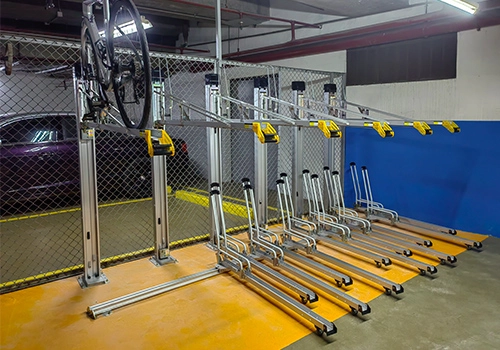
If you are planning a new bike parking zone, start with three questions: what types of bikes will park here, how many users will arrive at peak hours, and what space is available on site.
Do not maximize quantity first. Start with the minimum safe clearance, then calculate capacity. If the available area cannot meet standard spacing, consider splitting the parking into smaller clusters rather than cramming extra slots. Separate clusters also improve sightlines, which helps with security and natural surveillance.
Mark out the layout on the ground before installation. Use chalk or temporary stakes to simulate slots and aisles. Have team members test the space with different bike styles, especially e-bikes and wider-framed models. This simple test reveals conflicts that CAD drawings sometimes miss.
For large projects, we provide layout drawings. As a professional bike rack manufacturer, we work with landscape architects, city contractors and property managers to balance capacity, budget and safety. We can adjust rack selection and arrangement instead of forcing a dangerous dense layout.
Investing in correct spacing supports cycling adoption. When parking feels secure and convenient, more people choose to ride. For cities, this reduces traffic pressure and carbon emissions. For businesses, attractive bike parking draws eco-conscious customers and employees. For schools and hospitals, it creates orderly, low-conflict zones.
Conversely, poorly designed parking discourages cycling. If every trip ends with a battle to free your bike, riders revert to cars. The infrastructure investment fails to deliver its intended social and environmental returns.
Many buyers focus only on unit price. We encourage our clients to evaluate total value: long-term durability, lower complaint rates, better user satisfaction and reduced liability risk. A well-engineered bike rack system is not just metal on asphalt; it is part of a safe public transport ecosystem.
Rack spacing is easy to overlook, yet it defines whether bicycle parking works. Every inch of clearance is the result of practical observation, engineering testing and safety consideration. Too tight, and the space becomes frustrating and hazardous. Correctly calibrated, it lets cyclists park quickly, lock securely and retrieve their bikes without damage or stress.
At Suzhou Pioneer Vehicle, we do not only manufacture bike racks. We build parking systems built around rider safety. If you are sourcing commercial bike racks for a new development, campus renovation or municipal project, our team can recommend suitable models, share standard dimension references and help you design a layout that balances capacity, accessibility and long-term reliability.
Safe bike parking begins with measured, intentional spacing.