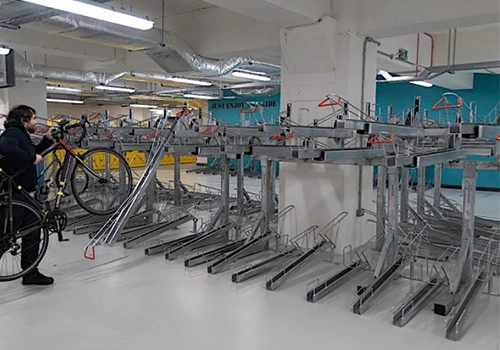
Fifteen years ago, a bike rack was a footnote in a site plan. Architects allocated a corner of the car park, a contractor bolted down three hoops, and nobody thought about it again. Today, the same city is likely to treat bike parking as a design decision on par with benches, lighting and paving. Bike racks have joined the family of urban furniture — objects that shape how a street feels, how people move and how a place is remembered.
That shift did not happen by accident. It followed a decade of changing travel habits, crowded streets, climate commitments and a new generation of cyclists who expect infrastructure to look and work as well as the bikes they ride. This article traces how bike racks became essential urban furniture, what good design now requires, and what buyers should look for when specifying bike parking for a city, campus or commercial development.
What Counts as Urban Furniture, and Why Bike Racks Belong There
Urban furniture — also called street furniture or site furniture — covers the objects placed in public space to serve the people who use it: benches, bollards, litter bins, lighting columns, wayfinding signs, planters, shelters and parking elements. These objects are not decorative extras. They are the interface between a city and its residents.
For a long time, bicycle parking sat outside that category. It was regarded as utilitarian hardware, closer to a service installation than to design. The logic was simple: cyclists needed somewhere to put a bike, so a metal bar was provided. Nobody asked whether it looked right, whether it survived the weather, or whether it made the street better.
That framing has broken down for a simple reason. Bike racks are visible, plentiful and used daily. A busy intersection might now hold more parked bicycles than parked cars, and every one of those bicycles is attached to a piece of hardware that pedestrians walk past, photograph and judge. When an object occupies that much public attention, appearance and placement stop being optional.
Cities recognised this through their own design guides. Many municipal street furniture manuals now include bicycle parking as a specified element with requirements for finish, colour, anchoring and integration with the surrounding streetscape. Procurement documents ask for powder-coated colours matched to the local palette, not generic galvanized grey. Bike parking has been formally absorbed into the urban furniture system.
Bike racks are now specified alongside benches in public realm schemes, and the standards applied to them are the same ones applied to any other long-life street element: corrosion resistance, vandal resistance, structural stability, consistent manufacture and a service life measured in decades rather than seasons.
How Cycling Culture Created the Demand
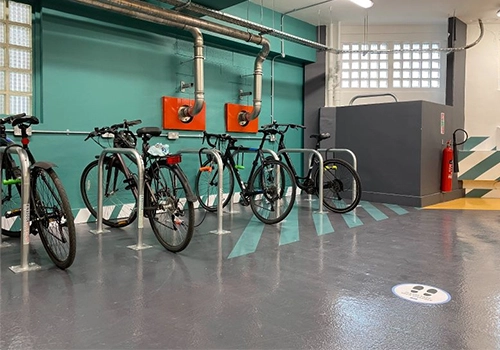
The demand for better bike parking came from several directions at once, and their combined effect is what moved the category from optional to essential.
The European Model
Cities such as Copenhagen, Amsterdam and Utrecht demonstrated that cycling can function as primary transport rather than recreation, provided the supporting infrastructure is complete. Their approach was not merely more bike lanes; it was the entire chain — routes, signals, parking at origins and destinations, secure storage at stations. That model spread through planning literature and study tours, and it established the expectation that a city serious about cycling must be serious about parking.
Congestion and Climate Policy
As congestion costs rose and emissions targets tightened, cities began treating cycling as a transport mode with measurable returns. Every commute shifted from car to bike reduces road demand, parking demand and transport emissions. But the shift depends on convenience, and convenience at the destination means parking that is close, available and secure. Bike parking became a policy instrument, not a courtesy.
The Post-Pandemic Acceleration
The pandemic period produced a sudden, visible surge in bicycle use across many markets, along with a surge in e-bike and cargo-bike sales. Streets that had tolerated a handful of hoops suddenly had queues. Cities responded with temporary parking installations, then with permanent programmes. Retailers and employers discovered that the parking they had was insufficient by an order of magnitude.
The E-Bike and Cargo-Bike Complication
The new bicycles are heavier and more expensive. An e-bike can weigh 25 kilograms or more; a cargo bike can be longer than a small car's wheelbase. Both cost far more than the bicycle of twenty years ago, which makes theft a bigger financial loss and security a bigger user concern. Racks designed for light road bikes no longer suffice — spacing, tube geometry and anchoring all need rethinking. This complication is one reason the market has moved toward engineered, purpose-built racks rather than improvised hardware.
The Functional Case: Why Parking Decides Whether People Ride
The strongest argument for bike parking is also the least glamorous one. Cycling rates rise and fall on the reliability of the destination end of the trip.
A cyclist weighing whether to ride to work, to a clinic, to a supermarket or to a station makes a quick mental calculation: will there be a safe place to leave the bike, will I be able to lock it properly, will it still be there when I return? If the answer is uncertain, the car wins. This is not a matter of enthusiasm; it is a matter of risk. Poor parking converts willing cyclists into drivers, and no amount of painted lanes compensates.
Good parking reverses that calculation. Secure locking points remove the theft anxiety. Adequate capacity removes the fear of arriving to a full rack. Convenient placement removes the extra walking distance that makes cycling feel like a hassle. Proper spacing removes the damage risk that makes owners of expensive bikes hesitate.
Cities that have measured this find consistent results: parking quality correlates with cycling mode share, and improvements in parking produce measurable increases in use. The infrastructure is cheap relative to its effect — a fraction of the cost of a road widening, with a comparable influence on how people choose to travel.
The Design Evolution: From Utility to Identity
The visual history of the bike rack closely tracks its rise in status.
Early racks were single-purpose hardware: a fork stand gripping a front wheel, or a horizontal rail to which a chain could be attached. These designs barely protected the bicycle and did nothing for the street. Their replacement, the inverted U or Sheffield rack, was a genuine engineering advance — simple, strong, lockable at frame and wheel, and eventually handsome enough to be repeated as a visual motif along a street.
From that foundation, the category diversified. Wave racks offered continuous capacity along a single bent bar, useful where linear space was available and intensity was moderate. Spiral racks compressed high capacity into narrow footprints for stations and dense urban sites. Each type solved a specific spatial problem, and each had to be engineered properly to survive real use.
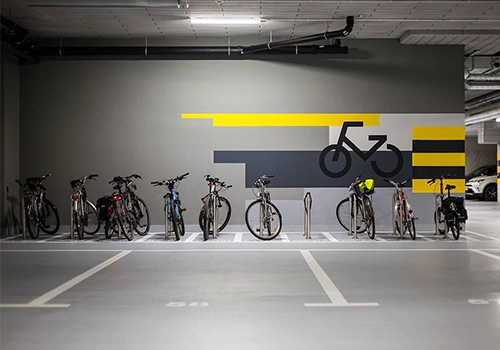
Then a different ambition emerged: racks as design objects. Cities began commissioning parking shaped to local identity — landmark silhouettes, wildlife forms, brand marks outside corporate headquarters, sculptural loops in cultural districts. These pieces are public art that happens to hold bicycles, and they are effective precisely because they combine function with recognisability.
The most recent layer is technology. Sensor-equipped racks report occupancy. Access-controlled compounds serve stations and workplaces. Charging points appear in covered parking for e-bike commuters. Not every site needs this, and many do not — but the availability of the option reflects how seriously the category is now taken.
What Makes Bike Parking Good Urban Furniture
Specifying bike racks as urban furniture means applying the standards of the category, not the standards of temporary hardware.
Material and Finish Integrity
Street furniture lives outdoors for decades. Hot-dip galvanized steel provides the corrosion resistance that public sites require, protecting the steel at scratches and cut edges as well as on the surface. Stainless steel, particularly grade 316, is the correct choice for coastal sites where salt accelerates attack on other finishes. Powder coating adds the colour and texture that allow racks to sit within a designed streetscape rather than stand apart from it.
Finish specification should include coating standards and measured thickness, not just a product name. A rack that rusts in year four is a failure of both aesthetics and asset management.
Coordination With the Streetscape
Good urban furniture reads as intentional. Racks matched to a project's colour palette, aligned with paving joints, and installed at consistent spacing look designed. Racks dropped at random angles look like a repair. Design coordination is cheap at the specification stage and impossible to correct after installation.
Structural Reliability and Anchoring
Furniture in public space is used hard. It supports loaded bicycles, resists leaning, absorbs knocks and sometimes survives deliberate attack. Wall thickness, weld integrity and anchor design determine whether the object stays true to its geometry over time. An embedded or securely anchored base is essential; freestanding racks drift, rotate and eventually fail.
Safety and Accessibility
Urban furniture must not create hazards. Rack spacing governs whether users can lock and retrieve bicycles without collisions, and whether aisles remain passable. Accessible parking needs wider slots and clear approach routes. Racks with sharp edges, protruding ends or trip hazards are liabilities rather than amenities.
Serviceability
Street furniture is maintained, occasionally repaired and sometimes struck by vehicles. Modular designs allow a single damaged hoop or anchor to be replaced without disturbing the rest of the installation. This is a procurement consideration that rarely appears on a quotation sheet but dominates the total cost of ownership.
The Commercial Case: Parking as an Asset
For commercial property owners and retailers, bike parking has shifted from compliance obligation to commercial asset.
Studies of retail districts in several markets have found that customers arriving by bicycle spend comparable or higher amounts per visit than drivers, while occupying far less parking space. A storefront with visible, well-designed bike parking captures that trade. A storefront without it loses it, sometimes to the shop next door.
For offices, bike parking supports recruitment and commuting policy. For transit operators, secure parking extends station catchment areas. For residential developers, quality cycle storage supports sales narratives about sustainable living. In each case, the rack itself is inexpensive relative to the value it unlocks.
Why Suzhou Pioneer Vehicle
At Suzhou Pioneer Vehicle, we manufacture bike racks as long-life urban furniture rather than temporary hardware. Our workshop carries out cutting, precision mandrel tube bending, welding, hot-dip galvanizing to recognised standards, and powder coating in specified RAL colours, with material and coating certificates issued per order. We produce U-racks, wave racks, spiral racks, artistic and custom designs, with stainless steel options for coastal and heavy-salting environments and standard galvanized ranges for inland municipal projects.
Custom bike racks are developed from site drawings, with geometry, spacing and anchoring specified against the actual bicycle mix a site will see. We supply installation drawings that state embedment depth, concrete requirements and anchor specification, and we can prepare technical datasheets, dimension references and lifecycle cost comparisons to support tender submissions.
Urban bike parking solutions for municipalities, campuses, transit hubs and commercial developments are built to consistent tolerances across production runs, so multi-phase projects receive matching geometry and finish rather than drifting batches.
Conclusion
Bike racks earned their place in urban furniture the same way benches and lighting did: by becoming too visible and too useful to be left to chance. Cycling culture raised expectations, congestion and climate policy created demand, and the new generation of heavier, more valuable bicycles made engineering quality non-negotiable.
The result is a category where design and durability must coexist. A rack that fails either test is a poor investment, whether it fails aesthetically in the streetscape or structurally after three winters. Buyers who specify materials, finishes, anchors and spacing deliberately get furniture that serves for decades, photographs well, and quietly does the work of encouraging more people onto bicycles.
If you are planning bicycle parking as part of a public realm, campus, transit or commercial project, our team at Suzhou Pioneer Vehicle can provide product documentation, layout guidance and quotations matched to your site conditions and specification requirements.


